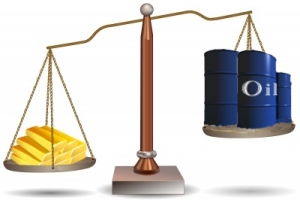
When we think of inflation we generally think of "Price Inflation" i.e. how much the price of a good or service has increased in dollars. However, price inflation is not "monolithic" that is, they don't all increase at exactly the same rate. Some prices will increase faster or more than others. So it is often useful to compare the price of one commodity to another to see the relative increases of each. Over the years we have compared a variety of different commodities including Gasoline vs. Oil and Oil vs. Bitcoin. We've even done a 3-way comparison of Gold vs. Dollar vs. Bitcoin. But since gold is historical money it is useful to use it as the standard yardstick. So we have updated … [Read more...]
Gold vs. Dollar vs. BitCoin Revisited
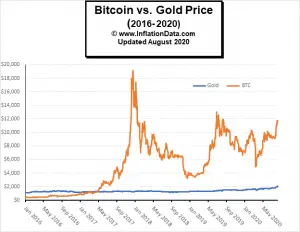
Back in 2016, we compared the properties of three types of currency, i.e. Gold, Dollars (Cash), and Bitcoin. Today we'd like to look at how each has fared since then. Back then, we said that there are 10 factors that make up a good store of value. They are: 1. Scarcity- For something to be considered valuable it can’t be too readily available. 2. Fungibility- Things have to be equal. Rare paintings aren’t fungible a Picasso isn’t exactly the same as a Monet. As a matter of fact, one Picasso isn’t even the same as another Picasso. Artwork isn’t fungible. One dollar bill is pretty much the same as another, one ounce of 24 karat gold is the same as another, one bitcoin is the same as … [Read more...]
3 Factors Causing the Current Gold Rally
A variety of factors affect the price of gold. Currently, many of them are combining to drive the price of gold to all-time record highs. Let's look at a few of the factors that affect the price of gold. 1) Uncertainty- Gold is a Crisis Hedge We have said this many times over the years but it bears repeating again gold is more of a crisis hedge than an inflation hedge. When uncertainty rears its ugly head... gold does well. That uncertainty can take many forms and one of them is "monetary uncertainty". So if people don't know what the value of their money is going to be in the future (i.e. inflation) they will shift some of their assets to gold (driving up the price of gold). So as far as … [Read more...]
5 Reasons to Invest In Gold
Gold has a long history that goes back to thousands of years. As we said here, "Gold came in common use in 3000 B.C. when Egyptians started making it into jewelry. It wasn’t until years later that gold began being used as a medium of exchange." It has cultural significance in most parts of the world. Throughout most of this time, gold was money. Paper or "fiat currency" did not exist until fairly recently. However, today the investment trends in gold have changed. Now, people invest in gold mostly for economic reasons. Investors all around the world buy it because they see gold as an inflation hedge. Here, in this blog, we'll discuss five important reasons to invest in gold right … [Read more...]
Gold Price and Its Relationship with Inflation
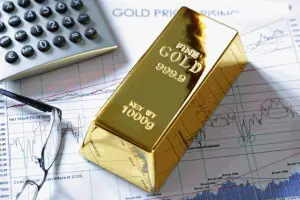
Inflation is the increase in the price you pay for goods and services, which affects the purchasing power of your money. This is more accurately called "price inflation" as compared to "monetary inflation". As inflation increases, the value of your money decreases. There are many different causes of inflation, but the most important cause is an increase in a country’s money supply. When the government decides to print money or implement a quantitative easing program, the money supply is increased (i.e. monetary inflation), thus affecting the general level of prices. As we can see in the following chart, the Federal Reserve engaged in three phases of quantitative easing i.e. QE1, QE2, … [Read more...]
Gold as an Investment
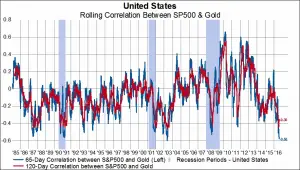
The main idea behind investment is to grow and preserve wealth, and in many cases, find unique ways to generate more income. Popular wisdom has it that when interest rates rise gold prices fall because the opportunity cost of holding a non-interest bearing asset is growing. However, contrary to popular wisdom, recent interest rate hikes by the US Federal Reserve have coincided with a rising gold price. At the same time, investor confidence in the stock market is faltering due to the FED's actions. Thus many investors can be seen rushing to the financial security offered by safe-haven assets such as gold. Rising Interest Rates Quantitative Tightening This is why gold … [Read more...]
How Does Inflation Affect the Price of Gold?
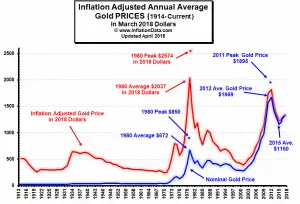
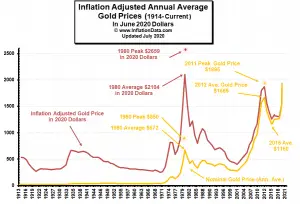
Gold bugs often fear inflation and believe that gold will generally increase in price when inflation is high. But the correlation is not as simple as when inflation increases the price of gold increases. If it were, the inflation adjusted price of gold would be virtually flat. And as we can see from the chart below the red line is far from flat. From 1913 through 1970 the "nominal price" of gold was fixed by the government and so it remained relatively stable but that didn't mean that the purchasing power of an ounce of gold remained stable. From 1880-1914 the U.S. dollar official gold price was $20.67 per ounce. But inflation was rampant in the economy (i.e. over 90% inflation just … [Read more...]
Investing in Gold
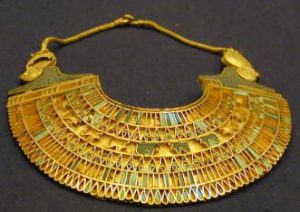
Throughout history, people have been attracted to gold. It is considered one of the most precious metals. In ancient times it was primarily used as jewelry or for fabricating religious items. Often gold was the only money so there was no such thing as "Investing in Gold" since holding gold coins was simply considered "saving". Today however, since our money is not based on anything but "the good faith and credit" of the government, investing in gold is not only possible but also advisable. But for all its history, there isn't really that much gold around. If you collected all the gold ever mined, from every corner of the Earth and put it into a single pile it would only fill a 5-story … [Read more...]
Choosing the Right Investment: Gold vs. U.S. Dollar vs. Bitcoin
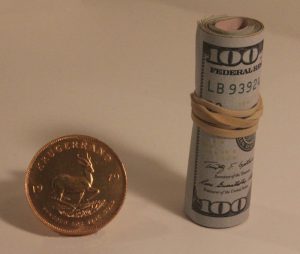
Rosland Capital recently produced an interesting infographic comparing the ten most important traits of an investment or more precisely of a store of value or currency. They offer physical gold and precious metals backed IRAs as a method to add stability to the mix. Including gold and other precious metals in your portfolio lowers your risk by diversifying from paper assets, thus hedging against the economy and inflation. The infographic compares Gold, the U.S. Dollar and Bitcoin showing how each ranks for these 10 characteristics on a scale of "High", "Moderate" or "Low". The ten important traits are: Scarcity- Being in short supply or rare. This is important because in order … [Read more...]
Should You Invest in Gold?
Almost everyone will agree that making the right investments is one of the best ways to secure your financial future. Unfortunately, figuring out which investments are right for you is easier said than done and everyone knows only crazy people invest in gold, right? It's easy to assume that just putting all your money in a bank account is the safest thing to do. But with today's almost non-existent interest rates even low inflation could cause you to have a net loss in purchasing power over time. So obviously you need to find something that will provide a bit better return to counteract the effects of inflation. To do that, traditional wisdom tells you that you have to take on higher … [Read more...]

