
In 1903, a lawyer in Germany took out an insurance policy and made payments on it faithfully. When the policy came due in twenty years, he cashed it in and bought a single loaf of bread with the proceeds. He was fortunate. If he had waited a few days longer, the money he received would have bought no more than a few crumbs. Germany had been on the usual fractional reserve gold standard prior to World War I, with the Reichsbank—its central bank—expanding the money supply at a “mild” 1–2 percent inflation rate. When war broke out in 1914, the government followed the standard policy of deficit spending rather than attempting to raise taxes. The Reichsbank’s role was to monetize the … [Read more...]
Two Ways to Destroy the Economy: Hyperinflation and Central Planning

In the following video, Professor Engelhardt says that if he were a "Super Villain" and wanted to destroy an economy, there are two ways that seem obvious to him. The first is "Central Planning", aka. "Socialism" and the Second is Hyperinflation. Since he would be a lazy super villain, he says Central Planning is "too much work", so he would choose hyperinflation. He goes on to say that hyperinflation is difficult to define; even Economists like Murray Rothbard and Ludwig Von Mises used different definitions of plain inflation depending on the context. Generally, inflation was originally defined as an "increase in the money supply in excess of the increase in the demand for money". More … [Read more...]
Hyperinflation in Turkey and Argentina Today?
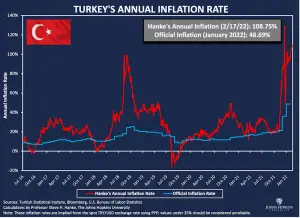
The Massive Gap Between Official Turkish Inflation and Reality The Turkish economy is a trainwreck. Labor is constantly striking for higher wages because inflation is so high. According to the Labor Studies Group, at least 56 worker strikes broke out in Turkey between January 12th and February 10th, and last year the Turkish currency lost 40% of its value against the U.S. Dollar. Interestingly, contrary to all mainstream Economists, Turkey’s President Erdogan insists that lower interest rates fight inflation. So he has kept interest rates artificially low, making the situation worse. Turkey’s falling exchange rate creates a problem for Turkish businesses that get their revenues in lira and … [Read more...]
Why Hasn’t the U.S. Dollar Experienced Hyperinflation?
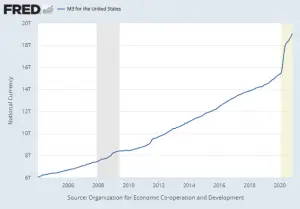
I recently answered this question on Quora and thought I'd share the answer here as well. Why hasn't the U.S. dollar experienced hyperinflation? That is an excellent question. As we can see from the chart the FED has engaged in 4 major phases of Quantitative Easing (QE) where they drastically increased their “assets” and one phase of Quantitative Tightening (QT) where they tried to decrease their assets. FED assets is sort of a euphemism for money printing. Basically, it involves creating money out of thin air and then buying something. That “something” becomes an asset on the FED’s books. Prior to 2008, the primary thing the FED bought was U.S. Treasury debt i.e. Treasury Bills, Bonds, … [Read more...]
Is the FED Tightening or Is Hyperinflation on the Horizon?
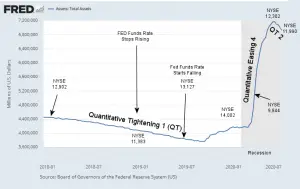
Recently a prophecy has been trending on YouTube. In it, the possibility of major upheaval in November is mentioned, combined with the possibility of hyperinflation. As I've mentioned before, beginning in March 2020, the FED created massive amounts of liquidity through Quantitative Easing in an effort to combat the monetary effects of shutting the country down due to the virus. If that is combined with a reduction in the quantity of goods and services created due to the virus or riots shutting down the means of production we could see hyperinflation. So that would play into fulfilling that prophesy. Back on April 1st, I wrote an article entitled Will the $2 Trillion Covid-19 Stimulus … [Read more...]
Can Crypto Solve Venezuela’s Hyperinflation Problem?
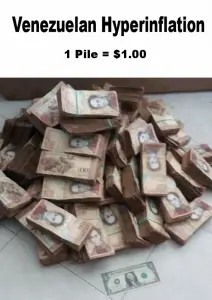
It is important to note that Hyperinflation doesn't just happen to a country's currency for no reason. In What is Hyperinflation? we found that "Hyperinflation is an extremely rapid period of inflation, usually caused by a rapid increase in the money supply. Usually due to unrestrained printing of fiat currency." Generally, the increase in the money supply is because the government can't pay its debts so it simply prints more money, these debts are usually the result of War, Corruption, or Fiscal Mismanagement. In Venezuela's case, the problem is not that they don't have the assets (they have some of the largest oil reserves in the world), but rather it is a result of their economic … [Read more...]
Hyperinflation: 5 Currencies that Self-Destructed
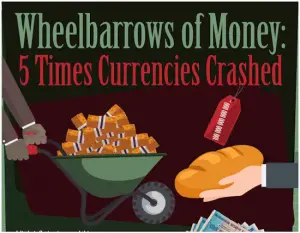
Over the years we have discussed Hyperinflation a number of times. We've explained that, "Hyperinflation is an extremely rapid period of inflation, usually caused by a rapid increase in the money supply. Usually due to unrestrained printing of fiat currency." Hyperinflation has been recorded as far back as Egypt 276 AD and is usually caused due to some sort of government mismanagement issue. Typically hyperinflation gets progressively worse until the curve goes hyperbolic and then something happens to end the progression. See What is Hyperinflation? for more information. Recently Commodity.com produced an Infographic of 5 currencies that were hit by hyperinflation so with their … [Read more...]
Syria in the Throes of Hyperinflation

Living in the United States or other "stable" countries, we tend to think that Hyperinflation is a relatively uncommon event but that is far from the truth. In our post What is Hyperinflation? We list 26 instances of hyperinflation 11 of which have occurred since 1990. It seems that every couple of years there is another one. Even in the midst of deflationary pressures we have seen Zimbabwe (which ended in 2008), North Korea (2010-13) and now Syria. In Surviving a Hyperinflation we noted that "Hyperinflation only occurs in countries where the government has already broken down. Weimar Germany was mired in a social Civil War… Zimbabwe never had a working democratic government and the … [Read more...]
Will Greece Follow Iceland or Weimar Germany?
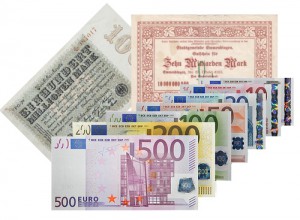
In Iceland the bankers were told to stuff it. In Weimar Germany they resorted to the printing press. Which model will modern day Greece follow?It seems that the words Weimar Germany and Hyperinflation are almost synonymous. The Weimar Republic (Das Weimarer Republik in German) is the name of the democratic government which was established in 1919 when Germany was defeated in WWI and Emperor Wilhelm II abdicated the throne. The problem came from the War repairations that were foisted upon Germany by the winners and the growing internal unrest which was allowing the Nazi's to gain a foothold. In an effort to pay their debts, promote full employment, and fight back against growing competitive … [Read more...]
What is the Significance of the Fiat Currency?

Last month in an article entitled What Is Fiat Currency? we told you that "Fiat currency is a term that is used to describe a currency which is created by “fiat” or “arbitrary order or decree” of the government." This month we would like to talk a little about the significance of Fiat currency. ~ Tim McMahon, editor. Fiat Currency Currency that is declared by a government to be a legal tender is referred to as a ‘Fiat Currency’. This type of currency owes its value strictly to the government’s acceptance of it for paying taxes and requiring its acceptance for "all debts public and private". It is not backed by reserves or any physical commodity and is defined as nonconvertible paper money … [Read more...]

